

This week I trained both models myself, end to end. One of them came out worse than the other, and it is the one that was supposed to be better.
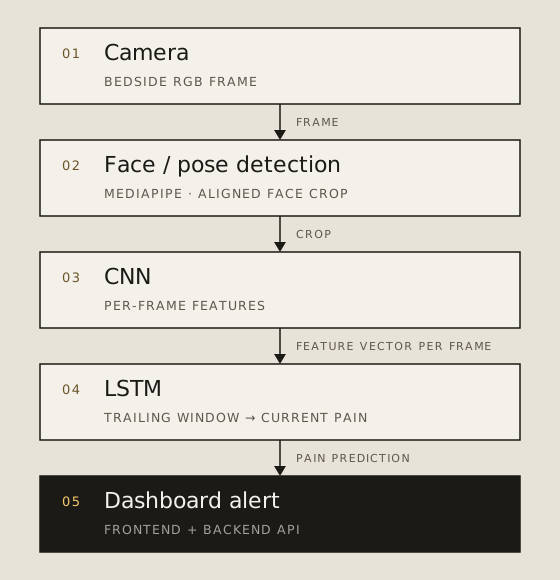
The CNN had never been trained
When I opened the CNN to wire the LSTM onto it, I found the backbone fully frozen. Nothing in it had ever been fit to our data. Every feature vector it had produced so far came from weights that knew nothing about pain.
So I trained it, with three changes:
- Unfroze layer4 and the head. The earlier layers stay frozen; the last block and the head now actually learn.
- Inverse-frequency weighted loss. About 94% of our frames are pain-free. As the dataset post showed, that imbalance is structural, not a preprocessing problem, so the fix has to live in the loss: without weighting, predicting "no pain" on every frame is almost free.
- Matched preprocessing to the live pipeline. Training was using a plain resize. The live pipeline feeds the CNN an aligned face crop. A model trained on one and served the other is being tested on a distribution it never saw, which is exactly the kind of mismatch the contract was written to catch. Training now uses the same aligned-crop approach.
Over 10 epochs, validation MSE settled between 0.5 and 0.6, with the best checkpoint at epoch 7 (0.519). Training MSE stayed noisier the whole way through. That is expected: the weighted loss makes each rare pain frame count for much more, so how many of them land in a given batch swings the batch loss a lot.
On the test set, the best checkpoint landed at [TODO: CNN TEST MSE, UNCONFIRMED].
The LSTM, and the gap
The LSTM takes the CNN's per-frame features, windows them, and predicts current pain from the trailing window. It is the whole reason our architecture has two stages: pain builds and holds, so a model that sees the last stretch of frames should do at least as well as one that sees a single frame.
Right now it doesn't. On the test set, the LSTM trails the CNN's frame-level number.
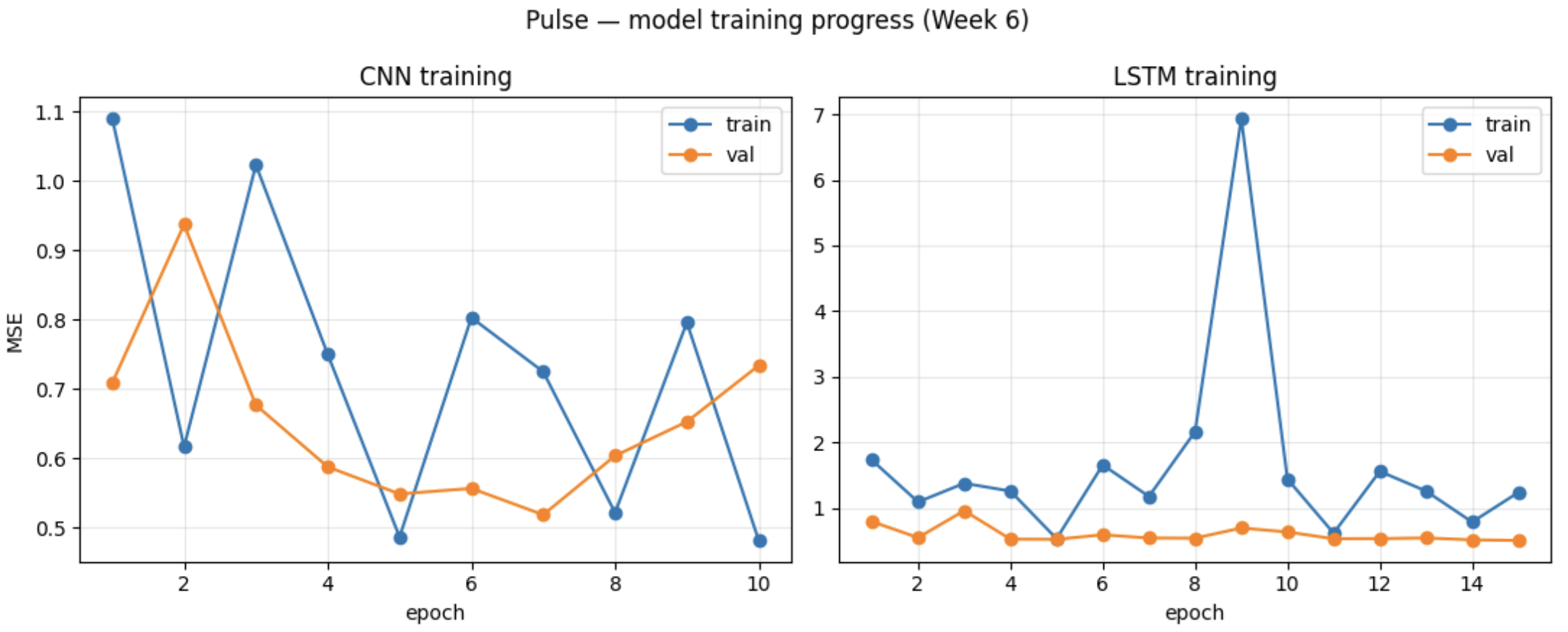
On validation the two are close, and the LSTM is slightly ahead: 0.502 against the CNN's 0.519. On test the order flips. A chart with only train and validation curves would hide the most important thing about this model right now, so I'm saying it here.
I haven't explained the gap yet. My leading suspicion is the split rather than the model. With 25 subjects, which people end up in the test set moves the number a lot, and a small test split can make a reasonable model look bad (or a bad one look reasonable). But that is a hypothesis, not a finding, and I'm still working through it. Until I can say which it is, the honest summary is: the LSTM currently underperforms the CNN, and I don't know why.