

A camera pointed at a bed is a surveillance object until you give it a reason not to be. We spent a week on the reason.
The first CAD had no display. It was a plain cube with a lens, and every single person we showed it to used the word "camera" within five seconds, often followed by a question about who was watching. That reaction is the actual design problem. The model can be perfect and it will still be unwelcome furniture.
What the face is for
The 240 × 240 round display exists to hold a low-resolution smile, and it does exactly one job: it tells the person in the bed what state the device is in, in a language that needs no reading and no explanation. Lit and smiling means it is watching and everything is fine. That is the whole message. It shows nothing else, no numbers, no status text, no logo.
- It is legible from a bed. Eleven pixels across at arm's length beats any text we could fit.
- It has one register: calm. A face is the fastest way to communicate "nothing is wrong" to someone who is unwell and cannot get up.
- It makes the object attributable. A thing with a face is a thing in the room with you, not an instrument someone else is pointing at you.
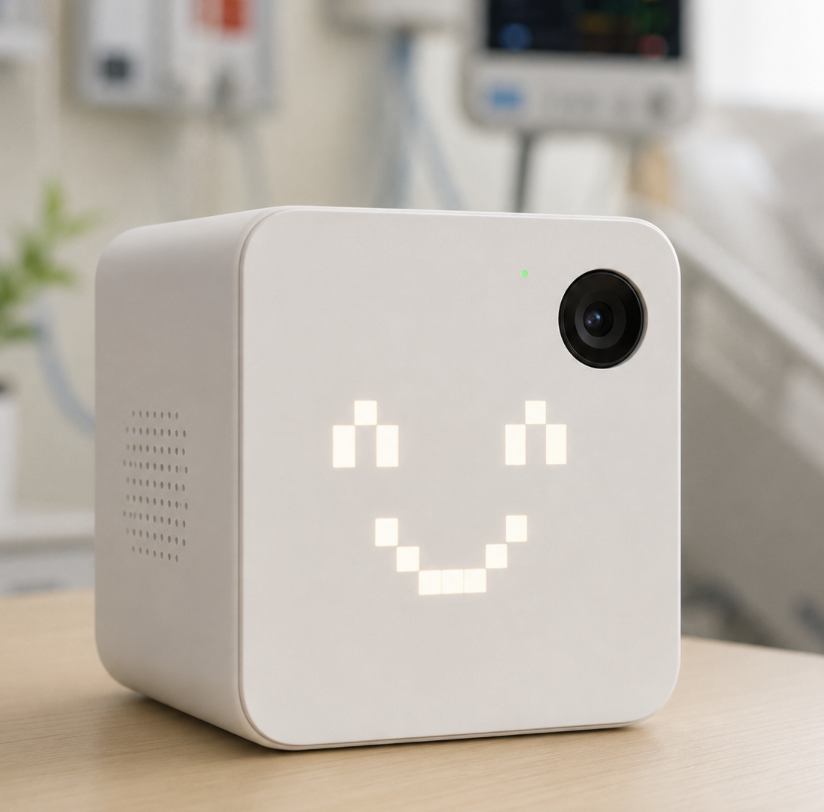
Two expressions, and a hard prohibition
We allow the face exactly two expressions. The resting smile, a sine-arc mouth, and a flattened, attentive line used only when an alert is being represented. That is the whole vocabulary.
The face never frowns and it never looks distressed. This is the one rule I will argue about.
The face represents the device. It does not represent the patient, and that distinction matters: its job is reassurance. A sad device implies either that the device is suffering, which is nonsense and a distraction, or, much worse, that it is acting as a proxy for the patient's suffering. The moment a person in pain looks up and sees a sad face looking back, we have built something that performs concern instead of fetching help. A frown also does the opposite of what an alert needs: it dramatises to the person who cannot act, while the person who can act is holding a phone in another room.
The site inherits the problem
This is also why the site does not look like monitoring equipment. If the pages were white, cyan, gridded and clinical, the pixel face would read as a decal stuck on a security camera, a friendly sticker on an unfriendly object. So the site is rendered in the device's own materials instead: the background is the shell colour, the accent is the LED, and every illustration on it obeys the same pixel grid the display does.
Amber, everywhere on this site, means you are looking at Pulse doing something: it is the device's own light, and nothing else gets to use it.
What is still unresolved
Blink timing. We randomise the blink between four and eight seconds, and to me it still reads slightly mechanical at the fast end. I suspect the answer is to tie it to the breathing rhythm rather than to a uniform random, but I have not tested that on anyone who was not already sick of looking at it.